Our Patron Saint
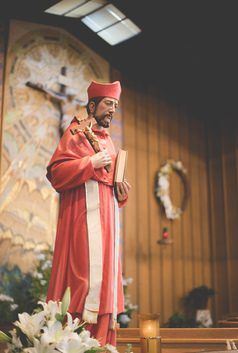
St. Robert Bellarmine (1542-1621)
Bishop & Doctor of the Church
Roberto Francesco Romolo Bellarmino was born on October 4, 1542, to a noble but impoverished family in southern Tuscany. Even from his youth, he was showing the promise of the great Church scholar he would later become, studying Church history and the lives and writings of the early Church fathers. He entered the Jesuit order in 1560 and was ordained in 1570, a time when his unique capabilities were desperately needed by the Catholic Church. His knowledge of the early Church fathers, coupled with his deep understanding of Scripture, enabled him to systematize the truth of Church doctrine in the face of challenges from early Protestant reformers.
Before ordination, his assignments of teaching, lecturing, and preaching were extraordinarily popular. Immediately after his ordination, he became a professor at the University of Louvain in Flanders, Belgium, and later at the Roman College, where his lectures and writing in defense of the Catholic faith produced a four-volume work that confounded the Church’s religious and political opponents. His writings were so profound and prolific that it was debated whether they could be the work of just one man.
More than just having a formidable intellect, St. Robert was known far and wide for his deep sanctity. From his teenage years in Jesuit college and seminary, his preaching drew crowds. Also, being short of stature, he had to stand on a stool in the pulpit to allow himself to be seen and heard. Although poor in health most of his life, he practiced severe austerity, denying himself the warmth of fire in the winter, living with only the barest of necessitities, and keeping to bread and garlic for his daily sustenance. Always a friend of the needy, he once tore off the hangings from the walls of his apartment to clothe the poor, with the justification that, “The walls won’t catch cold.”
Over the course of his 79 years, St. Robert was a priest, archbishop, author, cardinal, catechist, canonist, diplomat, papal counselor and advisor, professor, provincial, rector, scholar, spiritual director, theologian, a member of almost every Vatican congregation, and was given an active role in all the affairs of the Holy See.
St. Robert died on September 17, 1621. The process for his canonization began just seven years after his death, but was delayed for fear that it would prompt political turmoil and difficulties for the Church, from within and without, from those whom he successfully debated about the role of the Church in world affairs. He was finally canonized in 1930, and just one year later, Pope Pius XI declared him a Doctor of the Church. His remains, in a cardinal’s red robes, are displayed behind glass beneath a humble side altar in the Church of St. Ignatius, the chapel of the Roman College. He is the patron saint of catechists, catechumens, and canon lawyers.